Bankruptcy remnant assets
What bankruptcies leave behind, found and worked.
We find oil, gas, mineral and renewable assets left behind in bankruptcies. We research the record before anyone bids, and after closing we do the landman work: recording, division orders, suspense and curative. We work alongside investors who decide on each purchase and pay for it.
Buyers, their counsel and trustees also hire us for one piece of that work: a trace report on what an estate still holds.

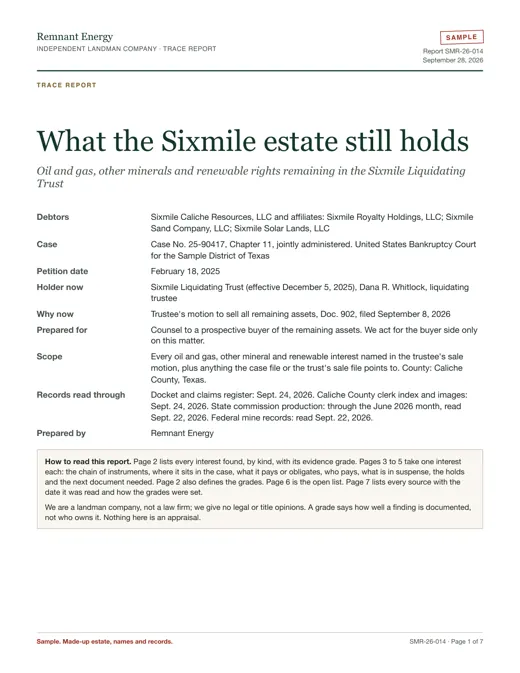
Sample Made-up estate, names and records. Painting: generated artwork, not a photograph.
Two ways to work with us
You need the record work
A trace report on what an estate holds
Remnant buyers, their counsel, trustees and the trade send the case and the question. We send back a report: each interest, whether it is alive, what it pays or obligates, who pays, what is in suspense, and how well the record supports each finding.
You bring the case; we do the research for you.
You want to see deals as a partner
A private memo on each deal, one at a time
We find the assets, screen the record and write a short memo: the estate, what we found and how sure we are, what is unknown, the sale deadline and the work plan. Partners decide yes or no and pay for the purchases they choose. We do the landman work after closing.
We bring the deal; you decide whether to take part.
Three kinds of asset
One trace, whatever the estate left.
A schedule line or an old company name is a place to start. For each interest the report answers five questions:
- What the estate actually holds
- Whether each interest or right is alive
- What it pays, or what it obligates
- Who pays, and what is held in suspense
- What holds it and the next document needed
Oil and gas
Working, mineral, royalty and overriding royalty interests, and the money held in suspense on them.
We read Leases, assignments, unit designations, state commission well and production records, payor statements.
Other minerals
Mineral interests and leases beyond oil and gas: sand, aggregate, lignite, metals, brine.
We read Leases and memoranda, county records, federal mine records, royalty statements.
Renewables
Solar, wind and storage leases, easements, land options and project sites.
We read The lease or option, recorded memoranda and notices, easements, and the mineral estate under the site.
For renewables we read the recorded rights and the agreements. We do not assess interconnection, capacity, site suitability or project value.
Who sends us work
Buyers, their counsel, trustees and the trade.
Who we act for is written into every scope. On a partner deal we act for the partners on it, and we do not trace for another bidder on the same sale.
Remnant buyers
When A trustee moves to sell "all remaining assets", or you already bought a set and want to know what is in it.
You send The case, the sale motion or bid package, anything the estate gave you.
Buyers' counsel and restructuring advisors
When A diligence question on a case, or an excluded or unscheduled asset turns up. Lenders and insurers ask the same way.
You send The question, the case, the documents you hold.
Trustees, estates and liquidating trusts
When Wind-down: what is left, what can be sold, what still obligates the estate.
You send The case, the schedules, the estate's own papers: payor statements, ledgers, agreements.
Mineral and royalty buyers
When A royalty or mineral position is put up for sale out of an estate.
You send The sale notice, the lease or legal description, the case.
The trade
When Operators, title firms, engineers and claims agents with a record question on a debtor's interests.
You send The question and the case.
The sample report
Seven pages on a made-up estate.
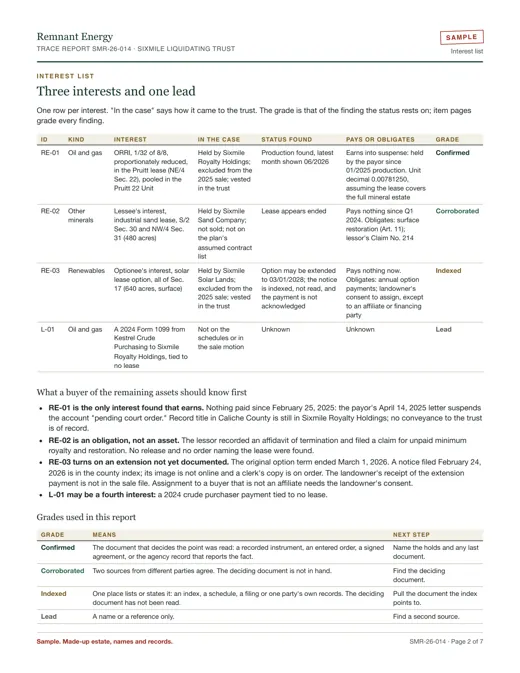
An overriding royalty in suspense with its payor, a sand lease that appears ended and still obligates the estate, a solar lease option whose extension is not yet documented, and a lead. The estate and every name and record in it are made up; the format is the one we deliver.
1. Cover
2. Interest list
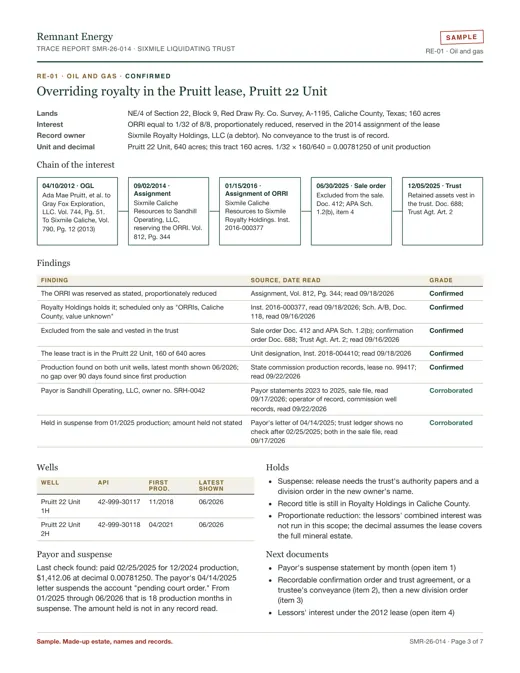 3. RE-01 Oil and gas
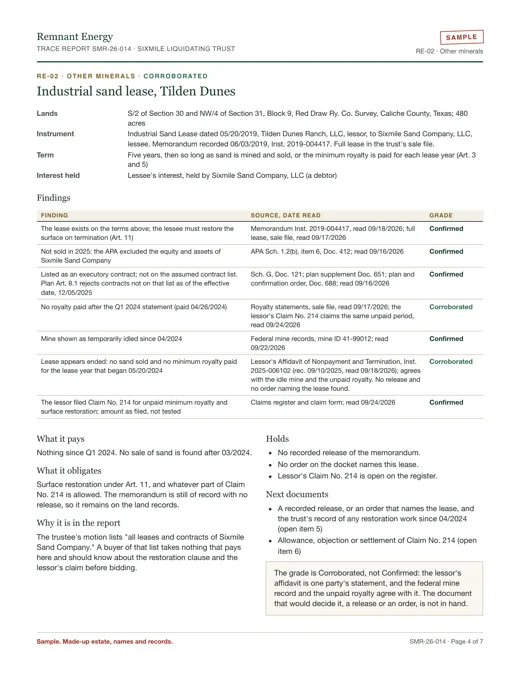 4. RE-02 Other minerals
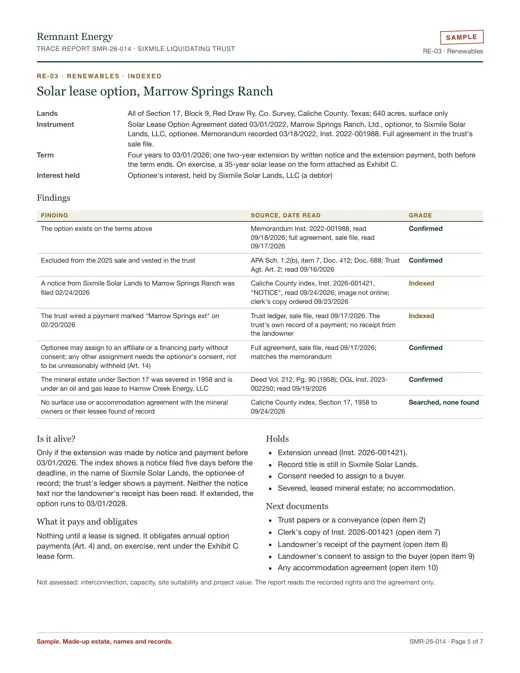 5. RE-03 Renewables
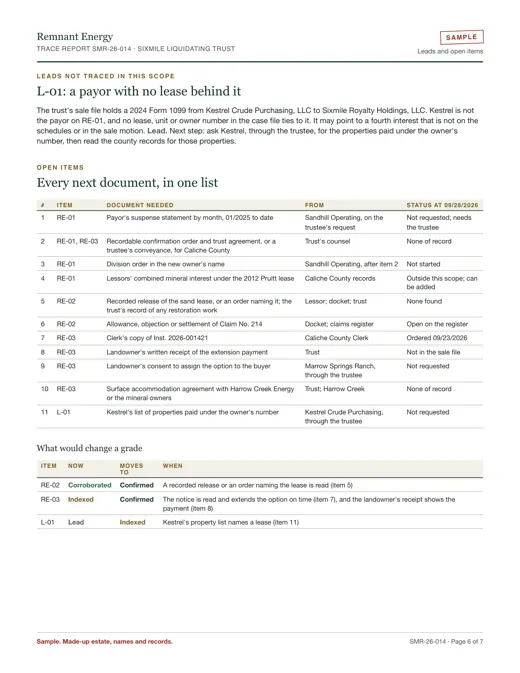 6. Leads and open items
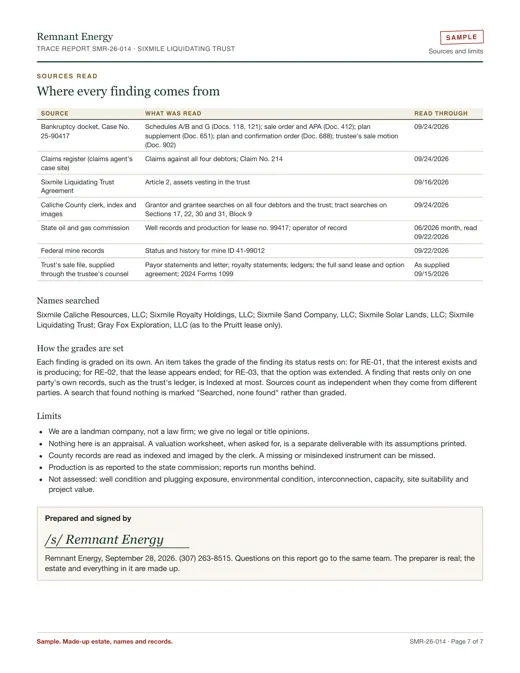 7. Sources and limits
Sample. Made-up estate, names and records.
How a trace works
Case file first, then the records.
A person reads the leases and the orders and sets every grade. Our records software pulls index entries and images; it does not decide anything.
Scope
Conflict check, then the case, interests, kinds, who we act for, deliverables, date and fee, in writing.
Read the case
Schedules, sale order, plan, trust agreement, claims register.
Classify
Sold, excluded, retained, abandoned, trust-held or unscheduled.
Trace
County, state commission and mine records, and the estate's papers.
Grade
Each finding graded; the next document named.
Report
One report, the documents it cites, one person to ask.
Evidence grades
How well each finding is documented.
A grade is a word, never a color alone. It says how well a finding is supported and what to read next. It does not say who owns the interest.
| Grade | Means | Next step |
|---|---|---|
| Confirmed | The document that decides the point was read: a recorded instrument, an entered order, a signed agreement, or the agency record that reports the fact. | Name the holds and any last document. |
| Corroborated | Two sources from different parties agree. The deciding document is not in hand. | Find the deciding document. |
| Indexed | One place lists or states it: an index, a schedule, a filing or one party's own records. The deciding document has not been read. | Pull the document the listing points to. |
| Lead | A name or a reference only. | Find a second source. |
Docket & Courthouse Guides
Common bankruptcy remnant title questions
How bankruptcy court orders interact with county real property records, lease expiration, and operator division order suspense.
Chapter 7 & Chapter 11 remnant sales
What a trustee's omnibus bill of sale or quitclaim actually conveys, and how to check whether the debtor still held record title.
Unscheduled minerals & ORRIs
How Bankruptcy Code Section 554 treats scheduled vs. unscheduled real property interests, and when an ORRI washes out on lease expiration.
Suspense funds & payor transfer
Recording the court chain in the county real property records so division order departments can release suspended revenues.
Request a trace
Tell us the case and the question.
We read every request and answer by email or phone. If a trace fits, you get a written scope before any work starts. Fees are agreed in writing for each matter.
Trustees and estates: we take requests through your counsel.
Investors and partners: choose "Investor or capital partner" and tell us what you look at, or read how partners work with us.
Or call (307) 263-8515, or email hello@remnant.energy.